
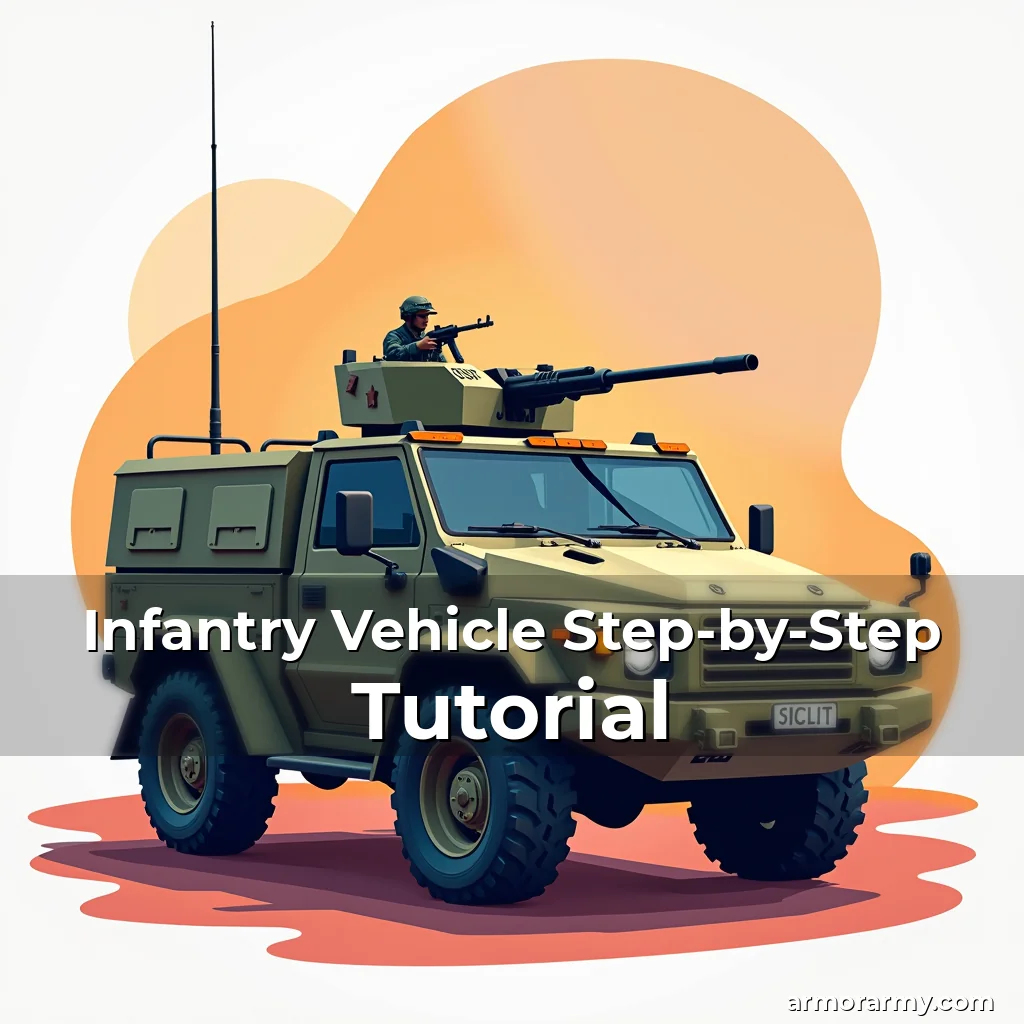
The Evolution and Strategic Role of Infantry Vehicles in Modern Combat
In the ever-evolving landscape of warfare, infantry vehicles have emerged as indispensable assets, transforming the way soldiers engage enemies across diverse terrains. These specialized machines combine speed, protection, and firepower to enable rapid deployment and tactical superiority. Their impact spans centuries, adapting to new technologies and battlefield demands.
From rudimentary transport carts to advanced armored fighting vehicles, the history of infantry vehicles reflects humanity’s quest for dominance on land. Today, they represent the pinnacle of engineering, integrating cutting-edge technology to meet complex operational needs in contemporary conflicts.
Understanding the Core Components of Infantry Vehicles
An infantry vehicle is engineered to serve dual purposes: transporting troops safely and supporting them in combat scenarios. Its design prioritizes mobility, protection, and versatility to adapt to varying battlefield conditions.
The chassis forms the structural backbone of the vehicle, determining its durability and ability to withstand enemy fire. It also houses critical components such as the powertrain, suspension system, and internal mechanisms. Modern designs often incorporate modular configurations to enhance flexibility.
Power sources vary depending on mission requirements, with diesel engines being standard due to their reliability and efficiency. Hybrid or electric alternatives are increasingly explored to reduce thermal signatures and environmental impact.
Suspension systems are tailored for specific environments—tracked suspensions excel in rough terrain, while wheeled variants offer superior road speeds. Both types undergo rigorous testing to optimize performance in contested zones.
- Armor Protection: Multi-layered composite plating defends against projectiles and improvised explosive devices (IEDs), often incorporating reactive装甲 that detonates upon contact to neutralize threats.
- Crew Compartment: Ergonomically designed interiors prioritize soldier comfort and safety, featuring blast-resistant seating, life-support systems, and emergency escape hatches.
Ammunition storage is carefully managed to prevent殉爆, with magazines and ordnance kept isolated from high-risk areas. Advanced materials like depleted uranium or ceramic tiles further reinforce critical zones against ballistic threats.
Communication systems integrate radio transceivers, digital networks, and encrypted channels to facilitate seamless coordination among units. Night vision and thermal imaging enhance visibility in low-light conditions or urban settings.
Interior layouts feature configurable seating arrangements that accommodate up to ten soldiers, along with provisions for medical supplies and casualty stabilization kits. Emergency lighting and ventilation systems ensure habitable conditions even in prolonged engagements.
Tactical displays provide crews with real-time data on fuel levels, weapon status, and navigational waypoints. Some models employ holographic interfaces to project maps onto transparent screens for better situational awareness.
Historical Development of Infantry Vehicles
The origins of infantry vehicles trace back to World War I, where trench warfare created urgent needs for mobile artillery platforms. Early iterations included horse-drawn wagons modified to carry mortars and machine guns into battlefields.
During the interwar period, nations experimented with half-tracks and fully tracked vehicles. The German Panzer I marked one of the first armored reconnaissance vehicles, demonstrating the potential of mechanized forces in future conflicts.
World War II accelerated innovation, leading to the creation of specialized Infantry Fighting Vehicles (IFVs) capable of delivering dismounted troops closer to objectives than traditional tanks allowed. Models like the Soviet BTR series became iconic symbols of combined arms doctrine.
Post-war developments focused on improving troop-carrying capacity and survivability. The U.S.-developed M113 Armored Personnel Carrier set industry standards with its aluminum alloy construction and adaptable turret options.
The late 20th century saw increased emphasis on lethality, resulting in IFVs equipped with powerful cannons and anti-tank guided missiles. NATO countries adopted standardized designs to streamline logistics and interoperability across allied forces.
Milestones in Infantry Vehicle Technology
Digital command control systems introduced in the 1980s revolutionized troop management inside vehicles, allowing commanders to monitor unit positions and coordinate movements remotely. These innovations reduced reliance on voice communications in chaotic environments.
Advances in material science led to lightweight composites offering greater protection-to-weight ratios. Armor-piercing rounds now pose fewer risks to vehicle integrity thanks to spaced armor tactics that fragment incoming projectiles.
The Iraq War highlighted vulnerabilities exposed by roadside bombs, prompting redesigns emphasizing mine resistance. V-shaped hulls and roll-over protection structures became standard features on newer models deployed after 2003.
Autonomous driving technology has been cautiously integrated into certain experimental prototypes, aiming to alleviate driver fatigue during long convoy missions or hazardous patrols in denied territories.
Strategic Roles in Battlefield Operations
Infantry vehicles operate as flexible platforms that seamlessly transition between transportation duties and direct engagement roles depending on mission parameters. They bridge gaps between static fortifications and dynamic assault phases characteristic of modern asymmetric warfare.
In offensive operations, these vehicles act as shock troops advancing alongside mechanized formations. Equipped with coaxial machineguns or 25mm/30mm automatic cannons, they suppress enemy defenses enabling friendly forces to establish footholds quickly.
Defensive applications leverage the vehicle’s mobility advantage against conventional tank armies. Rapid repositioning allows crews to exploit weak spots in enemy lines, creating temporary advantages that disrupt coordinated assaults.
Beyond immediate combat functions, infantry vehicles serve vital auxiliary roles. They evacuate wounded personnel rapidly, conduct surveillance sweeps, and distribute supplies to frontline units operating in extended supply chains.
Hospital ships adapted as mobile medical facilities, combining trauma care capabilities with protective armor plating. Such hybrid vehicles become critical assets during prolonged campaigns involving high attrition rates.
Offensive Capabilities Expansion
Modern IFVs boast sophisticated targeting systems that synchronize with aircraft and drones overhead. Laser designation links allow precise identification of high-value targets previously hidden behind natural obstacles or built-up areas.
Electronic warfare suites jam enemy radars and GPS signals, denying adversaries accurate positional information while protecting friendly forces from directed energy attacks. Jamming pods can be deployed externally when additional shielding becomes necessary.
Some models integrate drone launchers capable of deploying micro aerial scouts ahead of columns, identifying ambush sites or detecting enemy patrol routes. This preemptive intelligence significantly reduces casualties associated with surprise encounters.
Internal gunner stations utilize stabilized sighting systems allowing effective firing from moving vehicles. Computer-controlled turrets adjust aim dynamically compensating for vehicle movement and wind drift factors affecting projectile trajectories.
Design Considerations and Engineering Innovations
Creating effective infantry vehicles requires balancing conflicting priorities such as weight limitations versus protection levels, maneuverability trade-offs against cargo capacities, and cost-effectiveness measures against technological sophistication.
Vehicles intended for amphibious assaults must meet strict buoyancy criteria while retaining full combat effectiveness post-deployment ashore. Specialized seals and watertight compartmentalization achieve this delicate equilibrium without compromising firepower availability.
Urban warfare applications demand agile vehicles able to navigate narrow alleys and tight turns typical of cityscapes. Turreted weapons systems remain mounted centrally rather than extending outwards which would obstruct access through confined spaces.
Logistical considerations influence vehicle size; smaller platforms consume less fuel and require shorter transport corridors during mobilization efforts. Yet compactness sometimes comes at the expense of available ammunition reserves.
Eco-friendly initiatives drive research into alternative propulsion methods reducing dependence on fossil fuels. Hydrogen-powered prototypes show promise although infrastructure hurdles persist regarding refueling accessibility in forward bases.
- Modular Construction: Plug-and-play modules let operators swap-out weapon mounts, sensor packages, or medical bay configurations swiftly according to changing mission profiles.
- Survivability Enhancements: Active protection systems detect inbound threats mid-flight, firing countermeasures that intercept and destroy rockets, missiles, or shaped charges before impacting the hull.
Predictive maintenance algorithms analyze vibration patterns and acoustic signatures predicting potential mechanical failures hours before actual breakdown occurs. Proactive repairs minimize downtime maximizing overall fleet readiness percentages.
Nanotechnology experiments explore self-repairing surfaces that automatically seal minor damage from impacts, preventing corrosion or moisture ingress which compromises long-term service life expectancy figures.
Biometric authentication replaces physical keys for secure door entry procedures. Voiceprint recognition verifies authorized individuals attempting access during times when traditional locking mechanisms may fail due to extreme temperatures or pressure changes.
Operational Challenges Faced by Infantry Vehicles
Despite their robust designs, infantry vehicles encounter numerous operational constraints limiting their effectiveness in unpredictable battlefield situations. Environmental variables often dictate whether a particular model remains viable under specified circumstances.
Rugged terrain presents significant obstacles requiring specialized modifications. Mud-slick conditions decrease traction abilities unless vehicles possess deep-treaded wheels or reinforced tracks optimized for off-road performance metrics.
Weather extremes test vehicular resilience—frost heaves deform paved roads, sandstorms obscure optical sightlines, and monsoon rains transform open fields into impassable quagmires. Adaptation strategies range from deployable ground clearance kits to infrared-based navigation systems.
Enemy countermeasures evolve constantly threatening existing defense paradigms. Cyber warfare introduces electronic warfare dimensions targeting onboard computers responsible for managing critical subsystem functionalities.
Supply chain disruptions during protracted conflicts increase pressure on logistics departments struggling to maintain sufficient spare parts inventories across dispersed frontlines. Stockpiling replacements becomes an expensive endeavor demanding careful resource allocation decisions.
Training programs must continuously update curricula reflecting emerging threat landscapes. Simulated exercises expose crews to novel attack vectors never previously encountered by prior generations of militaries.
Interoperability issues arise when multinational coalitions employ incompatible systems lacking common communication protocols or joint sustainment agreements. Standardization frameworks attempt to mitigate these barriers though implementation remains uneven globally.
Case Studies and Real-World Applications
Famous battles showcase how well-adapted infantry vehicles can turn the tide of war. During Operation Desert Storm, U.S. Bradley IFVs provided essential fire support allowing Marines to advance undetected until reaching objective markers.
In Afghanistan, the Mine Resistant Ambush Protected (MRAP) variant saved countless lives compared to previous models vulnerable to IED explosions. Their V-shaped bodies deflected blasts away from occupants minimizing severe injuries or fatalities.
Israeli Merkava Main Battle Tanks demonstrate how deeply integrated vehicle designs prioritize crew survival. Armor extends beyond mere hull coverage encompassing entire turret assemblies for complete encapsulation protection.
Recent Ukrainian conflict experiences highlight the necessity of versatile platforms responding rapidly to evolving threats. Lightly armed scout cars proved invaluable scouting forward positions while heavier units maintained rear area security responsibilities.
British Warrior Infantry Fighting Vehicles underwent extensive upgrades adding 30mm L30A1 cannon mountings enhancing their role as direct fire platforms rather than merely serving as troop transports alone.
German Puma IFV showcases state-of-the-art active protection systems successfully defeating RPG-29 anti-tank grenades mid-air, illustrating advances in missile interception technology capable of neutralizing serious threats seconds before impact.
Canadian LAV III vehicles were retrofitted with anti-mine detection suites featuring seismic sensors warning drivers of concealed explosives lying beneath asphalt surfaces potentially triggering catastrophic detonations otherwise unseen.
Technological Advancements Shaping Future Infantry Vehicles
Ongoing research promises radical transformations in infantry vehicle capabilities driven primarily by breakthroughs occurring at intersections of artificial intelligence, robotics, and material sciences. Predictions suggest entirely new categories of vehicles arising from current developmental paths.
Unmanned Ground Vehicles (UGVs) currently serve remote sensing tasks but are progressing toward semi-autonomous operation roles assisting human crews carrying out dangerous assignments without risking loss of life unnecessarily.
Neural interface controls may eventually replace manual joysticks letting operators think commands through brainwave monitoring systems transmitting intentions directly into vehicle response protocols eliminating delays caused by traditional input mechanisms.
Self-healing polymers developed for aerospace industries hold tremendous potential application in automotive sectors regenerating damaged areas instantaneously restoring functionality lost from minor collisions or debris strikes.
Laser-based weaponry explores possibilities replacing kinetic projectiles altogether, offering pinpoint accuracy at longer ranges without generating massive spent casing waste traditionally found on modern battlefields today.
Hydrogen fuel cells appear poised to gradually supplant petroleum-based combustion engines providing cleaner energy outputs suitable for environmentally sensitive regions restricting emissions from military activities conducted within protected ecological zones.
Quantum computing simulations aid designers optimizing vehicle shapes achieving aerodynamic efficiencies unattainable via classical computational fluid dynamics approaches accelerating development cycles significantly reducing costs involved in prototyping stages.
Biomimetic materials inspired by biological organisms may lead to next-generation armor solutions exhibiting adaptive properties shifting densities accordingly reacting instantly against detected threats modifying their hardness states on microscopic levels adjusting responses dynamically based on perceived danger degrees.
Conclusion
As demonstrated throughout this examination, infantry vehicles continue evolving in complexity mirroring broader societal shifts occurring simultaneously in related scientific disciplines. Their strategic value lies not solely in destructive capacities but equally in their ability to safeguard and empower human operatives engaged in high-stakes confrontations.
To stay informed about ongoing progress shaping future generations of these vital machines, follow reputable defense news outlets tracking classified projects currently underway at premier military institutions worldwide. Engaging actively with expert discussions online fosters deeper comprehension facilitating personal growth in understanding intricate nuances defining modern warfare technology landscapes.

news is a contributor at ArmorArmy.com. We are committed to providing well-researched, accurate, and valuable content to our readers.