The Loadout Weight and Cost Planner
What your loaded vest and pack really weigh, which pouches fit before you buy them, the load against a comfort rule of thumb, and the cheapest pounds to take off
ArmorArmy.com's Plate Carrier Weight Calculator adds up a vest, the Gear Loadout Weight Calculator adds up a kit against your body weight, and the MOLLE Capacity Planner counts webbing. They never meet: the vest total never reaches the loadout, the planner estimates small pouches while you buy real ones with real footprints, and none of them asks what a pound costs to take off. This planner weighs every item once, totals the vest from your own weights, fits each pouch's columns and rows to your webbing before you buy it, and puts the load beside a 20% rule of thumb for comfort. In the worked example, two 10 lb training plates make a 26.7 lb vest (the ceramic menu figure said 18.7 lb), one pouch on the shopping list fits nowhere, and 38.1 lb at 172 lb is 22.2%, 3.7 lb over the line. After a free pound of cuts, the cheapest pounds cost $25.00 each and bring the load inside the line for $99.98, while the carrier and backpack a shop shows first cost $294.00 and leave it 0.2 lb over. Then it divides the kit by the outings you expect. Every figure is computed by the site's own calculators and every weight and price is an example; shares and pounds over the line round up, the line rounds down, costs round up, and it promises no price and no saving. It is about weight, fit and cost only: no protection ratings, threat levels or ballistic data, and no advice on choosing or buying armor. The 20% line is a rule of thumb for comfort, not a medical limit. Included: 24 printable pages, 7 steps, 4 working pages, reference tables, a quickstart, and a personalised sheet worked on the load, vest and webbing you enter in the calculators.
Look inside
Two full pages from the book, exactly as printed. Click either to read it at full size before you decide.
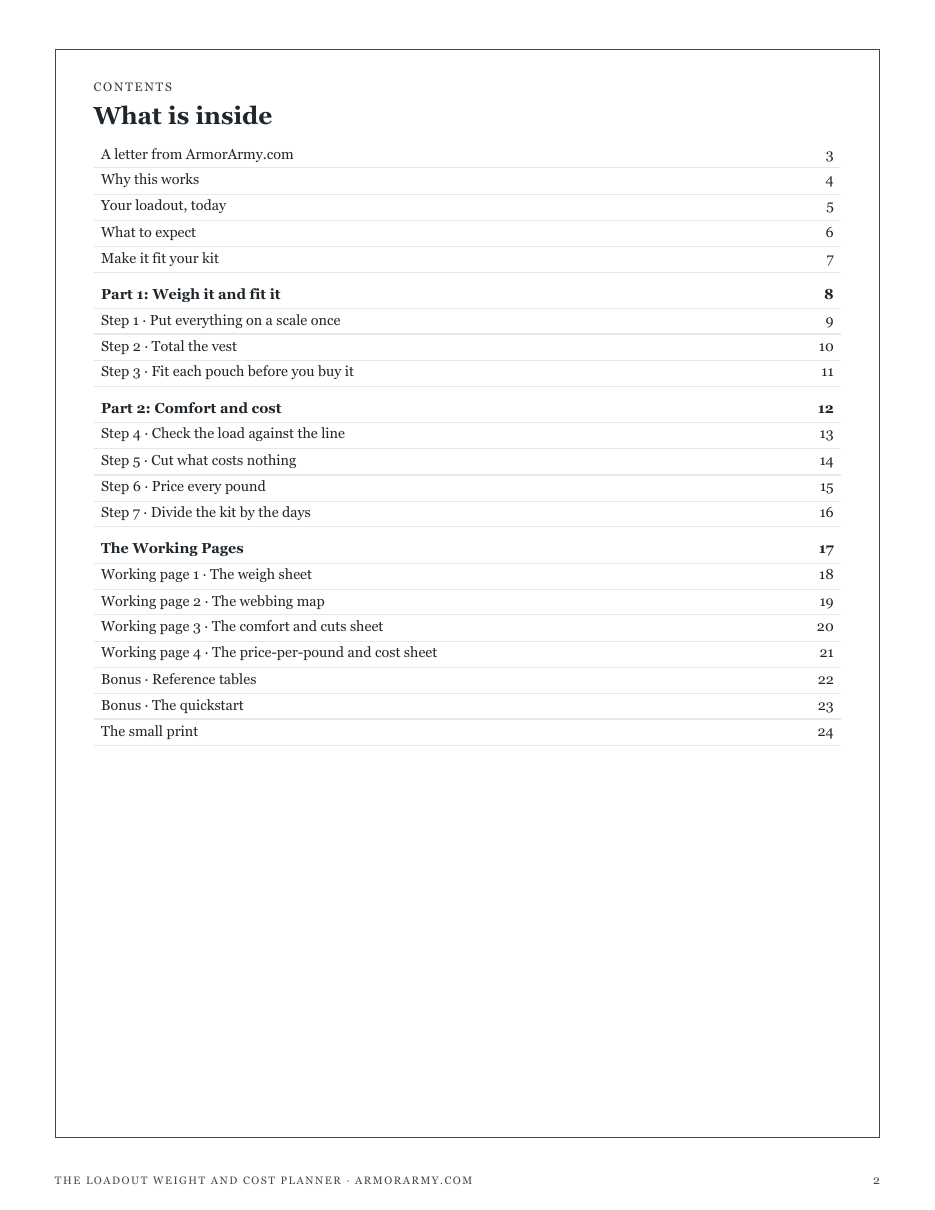
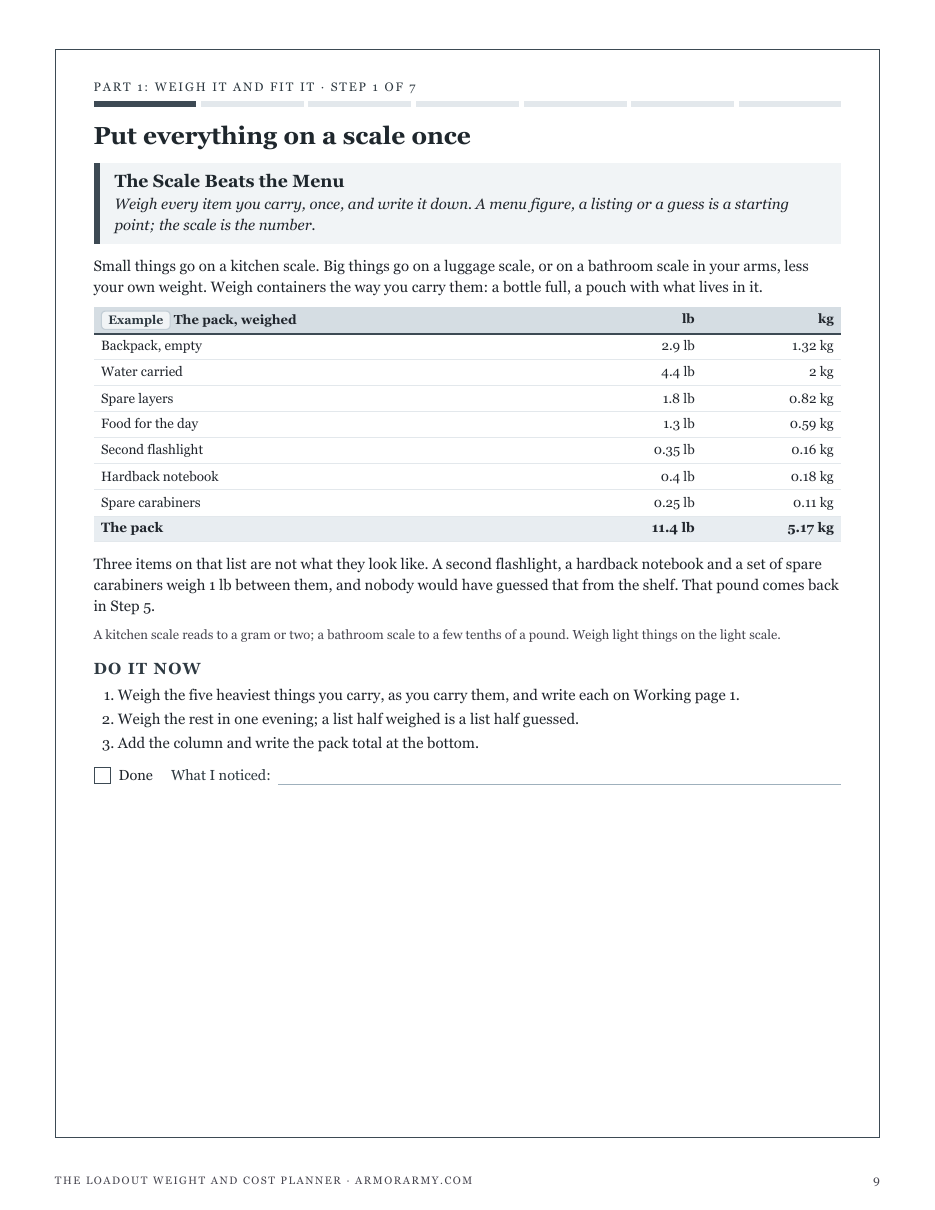
What is in it
- Step 1: The Scale Beats the Menu: weigh every item you carry once, as carried
- Step 2: Carrier, Plates, Pouches, Contents: the vest from your own weights, against the menu figure
- Step 3: Count Columns and Rows: fit each pouch's real footprint to your webbing before you buy it
- Step 4: Twenty Percent Is a Comfort Line: the load as a share of body weight, rounded up, against a rule of thumb
- Step 5: Free Cuts First: duplicates and spares of spares out, for nothing
- Step 6: Dollars per Pound Saved: every lighter option ranked, cheapest pound first, nothing past the line
- Step 7: Cost per Item, per Outing: the kit divided by the days you carry it
- Four working pages: a weigh sheet, a webbing map, a comfort and cuts sheet, a price-per-pound and cost sheet
- Reference tables: the 20% line by body weight, pounds to kilograms, the small-pouch estimate by field
- A quickstart and a personalised sheet worked on your own load, vest and webbing
- ✓ 24 printable pages
- ✓ 10 sections, worksheets and templates
- ✓ A second PDF worked out from the numbers you enter
- ✓ No account needed, just an email address
- ✓ Instant download; link valid 7 days
Price includes any taxes. Sold by GrabURL, who handle checkout and support. The charge appears on your statement as GrabURL.
The planner picks up where the free Gear Loadout Weight Calculator leaves off. The calculator totals a kit against your body weight; the book starts a step earlier, with every item on a scale, totals the vest with the Plate Carrier Weight Calculator, fits each pouch's real footprint to your webbing with the MOLLE Capacity Planner before you buy it, then puts the load beside a 20% rule of thumb for comfort, takes out what costs nothing, ranks every purchase by what a pound off costs, and divides the kit by the outings you expect. Every figure in it is an example, and it promises no price and no saving. It is about weight, fit and cost only: it contains no protection ratings, threat levels or ballistic data, and no advice on choosing or buying armor. A share of body weight is a rule of thumb for comfort, not a medical limit; if carrying a load causes pain, or you have an injury or a health condition, talk to a doctor or a physical therapist. Laws on owning or buying body armor vary by country and state; check your local law.