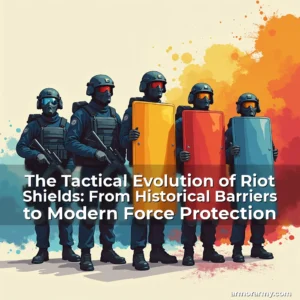
The Evolution and Tactical Significance of Riot Shields in Modern Law Enforcement
Riot shields have become an indispensable tool in modern law enforcement, serving as both protective gear and psychological deterrents during civil disturbances. These robust barriers are designed to withstand high-impact forces while allowing officers to maintain their mobility and situational awareness in volatile environments.
From their early iterations made of wood and leather to today’s advanced composite materials, riot shields have evolved significantly over time. This evolution reflects the ongoing need for better protection against increasingly sophisticated forms of protest tactics and violent confrontations.
Historical Development of Riot Shield Technology
The origins of riot shielding can be traced back to ancient times when warriors used wooden boards reinforced with metal fittings to deflect projectiles. However, these rudimentary designs lacked the sophistication required for modern policing scenarios.
In the late 19th century, police departments began adopting standardized shield models crafted from laminated wood and steel plates. This marked a significant advancement in creating durable yet manageable protective equipment for crowd control operations.
By the mid-20th century, manufacturers introduced new materials such as polycarbonate and fiberglass that offered superior impact resistance compared to traditional metals. These innovations allowed for lighter weight without compromising structural integrity.
- Material Advancements: The transition from metal alloys to synthetic composites revolutionized shield design by reducing weight while maintaining durability.
- Ergonomic Improvements: Modern shields incorporate contoured grips and adjustable straps to enhance user comfort during prolonged use.
The digital age has further transformed riot shield technology through integration with smart systems. Some units now feature embedded sensors capable of detecting impacts and transmitting data wirelessly to command centers for real-time monitoring.
Modern Design Features and Manufacturing Innovations
Contemporary riot shields are engineered with multi-layered construction techniques that combine ballistic-grade plastics with reinforcing mesh structures. This hybrid approach provides optimal protection against various threat levels encountered in dynamic situations.
Manufacturers employ computer-aided design software to optimize shield geometry, ensuring maximum coverage area while minimizing obstruction of peripheral vision. Advanced ventilation systems also prevent heat buildup inside the shield enclosure.
A key innovation is the development of modular shield components that allow for quick replacement of damaged panels without requiring complete unit overhaul. This feature enhances operational efficiency during extended deployments.
Statistical Insights on Material Performance
According to a recent study conducted by the International Police Equipment Association, modern composite shields demonstrate up to 60% greater impact absorption capacity than conventional steel models. This improvement translates directly into enhanced officer safety during intense confrontations.
Data analysis reveals that shields constructed with Kevlar-reinforced polymers exhibit exceptional resistance to fragmentation threats commonly encountered at protests involving Molotov cocktails or glass bottles.
Tactical Applications Across Different Law Enforcement Scenarios
Riot shields serve critical functions across diverse law enforcement contexts, including public demonstrations, prison riots, and active shooter incidents. Their versatility makes them essential equipment for tactical response teams worldwide.
During mass gatherings, shield walls form strategic defensive lines that protect officers while enabling controlled movement through crowds. This formation allows for effective crowd management without resorting to excessive force measures.
In correctional facilities, specialized riot shields equipped with non-lethal weaponry attachments provide containment capabilities during inmate uprisings. These adaptations ensure rapid response without endangering staff lives unnecessarily.
Their application extends beyond urban settings; rural law enforcement agencies utilize compact versions for dealing with agitated livestock or unpredictable wildlife encounters where standard body armor might be insufficient.
Training Protocols and Operational Procedures
Effective utilization of riot shields requires rigorous training programs that emphasize teamwork coordination and precise positioning techniques. Officers must master formations that maximize collective defense effectiveness.
Safety protocols dictate strict guidelines regarding line spacing, angle orientation, and synchronized movement patterns to minimize exposure risks while advancing through hostile environments.
Regular drills simulate realistic confrontation scenarios using mock combatants who replicate common protester behaviors. This immersive training helps reinforce muscle memory crucial for reflexive responses under pressure.
Cross-training between different department units ensures seamless interoperability during joint operations. Standardized communication codes help maintain clarity amidst chaotic conditions.
Psychological Impact on Protest Dynamics
Beyond physical protection, riot shields exert a profound psychological influence on crowd behavior. Their imposing presence often deters escalation by signaling institutional preparedness and resolve.
Studies indicate that visual cues associated with armed personnel wielding shields contribute to de-escalation efforts by establishing clear boundaries within protest zones. This perceived authority encourages peaceful resolution rather than violent confrontation.
However, there exists debate among social scientists regarding the ethical implications of using intimidating displays during civic dissent movements. Critics argue that such tactics may exacerbate tensions instead of mitigating them.
Despite controversies, most law enforcement agencies maintain that responsible deployment of shields aligns with constitutional mandates aimed at preserving public order while respecting citizens’ right to assemble peacefully.
Comparative Analysis with Alternative Protective Gear
While riot shields offer distinct advantages in certain scenarios, they are not universally applicable. Comparative assessments reveal trade-offs depending on specific mission requirements and environmental factors.
Body armor provides individual protection but lacks the communal defense benefits inherent in shield wall configurations. Conversely, riot shields cannot replace full-body armor in direct engagement situations where close-quarters combat is anticipated.
Helicopter-borne shields represent another niche variant developed for aerial interventions during large-scale emergencies. These specialized units enable rapid deployment above ground level, offering unique tactical advantages.
Each type of protective equipment carries its own set of limitations and strengths. Successful operations typically involve coordinated use of multiple asset types tailored to specific operational needs.
Economic Considerations and Cost-Benefit Analysis
The procurement and maintenance costs of riot shields present significant financial considerations for municipal budgets. Comprehensive cost-benefit analyses are essential before acquiring large quantities of protective gear.
Although initial investment appears substantial, long-term savings emerge from reduced medical expenditures related to officer injuries. Studies show that well-equipped units experience lower injury rates during high-risk engagements.
Maintenance expenses vary based on material composition and usage frequency. Composite-based shields generally require less frequent repairs compared to their metallic counterparts due to superior corrosion resistance properties.
Some jurisdictions explore leasing options or shared resource agreements with neighboring municipalities to manage budget constraints effectively while maintaining adequate protective capabilities.
Futuristic Trends and Technological Innovations
Ongoing research aims to integrate augmented reality features into future riot shield designs, enhancing situational awareness through heads-up displays showing vital information overlays.
Nanotechnology applications promise breakthroughs in lightweight materials capable of providing bulletproof protection equivalent to current steel reinforcements but weighing only fractions of existing models.
Smart textiles embedded with conductive fibers could revolutionize shield functionality by incorporating flexible circuitry for integrated communications and biometric monitoring capabilities.
Autonomous drone-mounted shield platforms represent an emerging concept currently being tested for perimeter security applications in high-threat environments such as international summits or military installations.
Ethical Dimensions and Legal Frameworks Governing Shield Usage
The deployment of riot shields raises complex ethical questions concerning proportionality, necessity, and potential misuse of force. Clear legal frameworks guide appropriate usage parameters established by judicial authorities.
International human rights organizations monitor shield deployment practices globally to ensure compliance with standards prohibiting unnecessary violence against civilians participating in lawful assemblies.
Transparency mechanisms include mandatory reporting procedures detailing each instance of shield usage along with justification rationale provided by commanding officers involved in decision-making processes.
Public accountability initiatives encourage citizen oversight committees composed of independent experts tasked with evaluating police conduct during sensitive events involving shield deployment.
Case Study: Notable Deployments and Outcomes
An examination of historical incidents featuring prominent shield usage offers valuable insights into practical applications and resulting consequences. One notable example occurred during the 2011 London riots where extensive shield deployments played pivotal roles in restoring order.
Analysts credit the structured formation strategies employed by Metropolitan Police officers with preventing further escalation despite overwhelming numbers confronting them. Post-event evaluations highlighted the importance of disciplined maneuvering techniques in managing large-scale unrest.
Contrastingly, some cases have demonstrated unintended repercussions from shield usage. In particular instances, overly aggressive deployment approaches led to heightened civilian resentment and subsequent waves of intensified protest activity.
These contrasting outcomes underscore the need for continuous refinement of operational doctrines governing shield employment alongside comprehensive training regimens focused on conflict de-escalation principles.
Conclusion
Riot shields remain a cornerstone element in contemporary law enforcement arsenals, embodying decades of technological progress and tactical adaptation. Their continued relevance stems from the ever-evolving nature of public safety challenges faced by modern societies.
To ensure responsible and effective use, ongoing investment in innovative materials, rigorous training protocols, and transparent governance frameworks proves essential. By embracing these multifaceted approaches, law enforcement agencies can uphold public trust while safeguarding personnel against escalating threats in turbulent times.