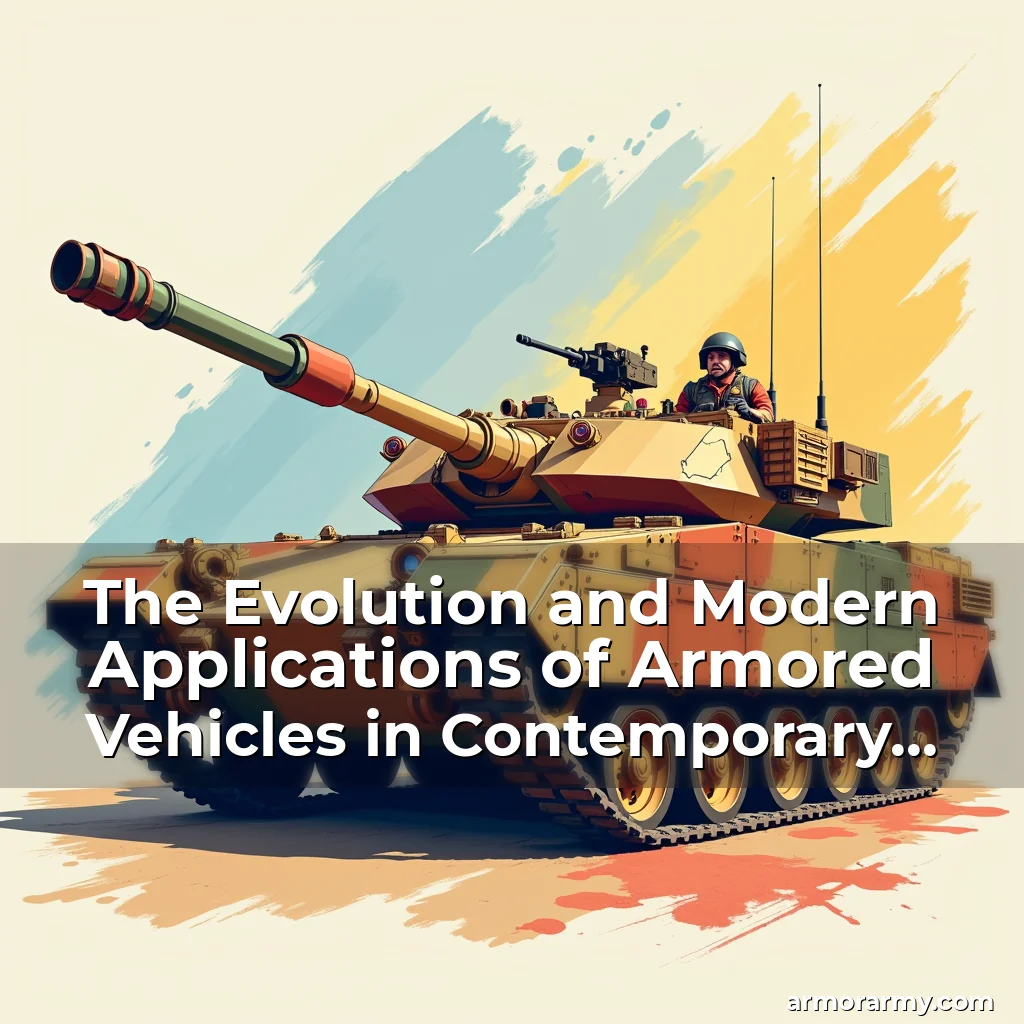
The Evolution and Modern Applications of Armored Vehicles in Contemporary Warfare
In the ever-evolving landscape of military technology, armored vehicles have remained a cornerstone of defense strategies across nations. From their inception during World War I to their sophisticated forms today, these machines are designed not only for protection but also for versatility and firepower.
Modern armored vehicles serve dual purposes—protecting personnel from hostile environments while enabling them to engage effectively in combat scenarios. Their development has been driven by advancements in materials science, engineering, and tactical requirements that continue to shape battlefield dynamics.
Historical Development of Armored Vehicles
The origins of armored vehicles trace back to the early 20th century when technological innovations began to reshape warfare. The first tanks were developed during World War I as a means to overcome the challenges posed by trench warfare.
Tanks introduced mobility, gunpower, and protection in a single platform, revolutionizing how battles were fought. This marked a significant shift from traditional cavalry units to mechanized forces capable of traversing difficult terrains.
The interwar period saw further experimentation and refinement of tank designs. Engineers worked tirelessly to enhance speed, armor thickness, and weaponry capabilities, laying the groundwork for future developments.
World War II accelerated the evolution of armored vehicles, leading to diverse types such as light, medium, and heavy tanks. These variations catered to different strategic needs, including reconnaissance missions and direct assaults.
- Mechanization: Tanks replaced horse-drawn units, allowing faster movement and greater operational range over vast battlefields.
- Airborne Assaults: During WWII, airborne troops used specialized armored vehicles for rapid deployment behind enemy lines, enhancing surprise attacks.
Types of Armored Vehicles Today
Today’s armored vehicle fleet encompasses various categories tailored for specific roles within modern armies. These include main battle tanks (MBTs), infantry fighting vehicles (IFVs), armored personnel carriers (APCs), and specialized variants such as command posts and recovery vehicles.
Main Battle Tanks remain at the forefront due to their combination of armor, firepower, and mobility. They are engineered to dominate both offensive and defensive operations through advanced composite armors and powerful cannons.
Infantry Fighting Vehicles provide transport and support for dismounted soldiers, equipped with weapons systems that allow them to fight from inside the vehicle or disembark quickly under fire.
Armored Personnel Carriers primarily focus on troop transportation and light protection against small arms fire and shrapnel. However, some models can be upgraded with additional armor plating depending on mission requirements.
Variants and Specializations
Specialized armored vehicles address niche operational demands beyond standard configurations. Examples include mine-resistant ambush protected (MRAP) vehicles used extensively in Iraq and Afghanistan to counter improvised explosive devices (IEDs).
Command and control vehicles house critical communication equipment necessary for coordinating large-scale military operations efficiently. They often feature reinforced structures alongside advanced digital interfaces.
Recovery vehicles play an essential role in maintaining readiness by providing field maintenance services; they carry tools and spare parts required to repair damaged vehicles swiftly without returning them to base facilities.
Technological Innovations Enhancing Armor Effectiveness
Advancements in material sciences have significantly improved the protective capabilities of armored vehicles. Traditional steel armor is now supplemented with composite materials offering superior resistance against ballistic threats.
Active Protection Systems represent another breakthrough where radar-guided interceptors detect incoming projectiles mid-flight before detonating them safely away from the vehicle’s hull. This proactive approach enhances survivability rates dramatically.
Stealth technologies aim at reducing detection signatures via radar cross-section minimization techniques applied externally along with internal noise suppression mechanisms targeting thermal emissions.
Digital integration allows real-time data sharing between friendly units using encrypted networks ensuring seamless coordination even amidst chaotic battlefield conditions.
Critical Components That Define Modern Armored Vehicles
An effective armored vehicle relies heavily upon its powertrain system which determines overall performance characteristics including acceleration times and fuel efficiency metrics crucial for prolonged engagements.
The turret assembly houses primary weapon systems ranging from high-velocity rifled barrels up to guided missile launchers capable of engaging targets at extended ranges accurately.
Survivability features encompass not only physical armor layers but also blast mitigation measures protecting occupants from underneath explosions common in asymmetric conflict zones.
Ergonomic design considerations ensure crew comfort during long deployments minimizing fatigue levels thereby improving reaction speeds when faced with sudden threats.
Operational Roles Within Military Doctrine
Armored vehicles fulfill several key functions within contemporary military doctrine spanning land-based conflicts right through maritime interventions supported by amphibious assault craft carrying tracked platforms onto beaches.
Offensive operations typically involve MBTs spearheading advances through enemy territory leveraging combined arms tactics involving artillery support and aerial bombardments preceding ground assaults.
Defensive postures rely on entrenched positions fortified with layered defenses complemented by mobile reserves ready to respond dynamically against potential breaches.
Logistical resupply missions require APCs transporting supplies securely across contested areas ensuring uninterrupted flow of ammunition food water etc., vital for sustaining front-line units.
Challenges Faced by Operators and Technicians
Maintaining complex machinery poses ongoing logistical hurdles especially considering remote locations where access might be limited thus necessitating robust self-repair kits aboard each unit.
Crew training programs must evolve continuously incorporating virtual reality simulations exposing operators familiarize themselves thoroughly prior actual engagement scenarios likely encountered overseas.
Environmental factors influence effectiveness notably extreme temperatures affecting mechanical components requiring regular inspections frequency adjusted accordingly based regional climate profiles.
Safety protocols mandate strict adherence procedures particularly concerning handling hazardous substances stored onboard such as fuel tanks located beneath decks needing periodic checks for leaks corrosion signs.
Futuristic Trends Shaping Next Generation Designs
Emerging trends suggest increased reliance upon unmanned systems operating autonomously either independently executing tasks assigned remotely controlled human oversight retaining decision-making authority over lethal force applications.
Modular construction approaches enable customization according to theater-specific needs facilitating quick reconfiguration transitions between differing mission sets without extensive modifications altering fundamental structure integrity.
Integration of artificial intelligence promises enhanced situational awareness processing massive datasets instantaneously identifying patterns predicting adversary movements assisting commanders formulate optimal response plans proactively rather than reactively.
Energy-efficient propulsion solutions aiming reduce dependency fossil fuels aligning broader global initiatives promoting sustainability reducing carbon footprint associated vehicular operations worldwide.
Conclusion
The journey from rudimentary armored vehicles to today’s technologically advanced platforms underscores continuous innovation shaping military capabilities globally. As new threats emerge so too do corresponding adaptations aimed countering those dangers effectively preserving national security interests.
For members of the armor army community understanding historical context current implementations emerging technologies remains paramount ensuring preparedness facing evolving challenges ahead while contributing positively towards peacekeeping efforts wherever deployed internationally.